Vector Classification
Vectors can also be used to solve classification problems in Machine Learning.
Classification is the task of assigning items to discrete categories. For example, recognising handwritten letters is a classification problem because each letter belongs to one of 26 categories. In contrast, temperature is not a classification problem because it varies continuously.
Example: Classifying Plants
Suppose we have data for 12 plants belonging to two species (A and B), with the following features:
- Average temperature where the plant grows
- Number of flowers
We can represent each plant as a vector in a 2D feature space: - X-axis → temperature
- Y-axis → number of flowers
Plotting the data and colour-coding by species:
- Green → Plant A
- Red → Plant B
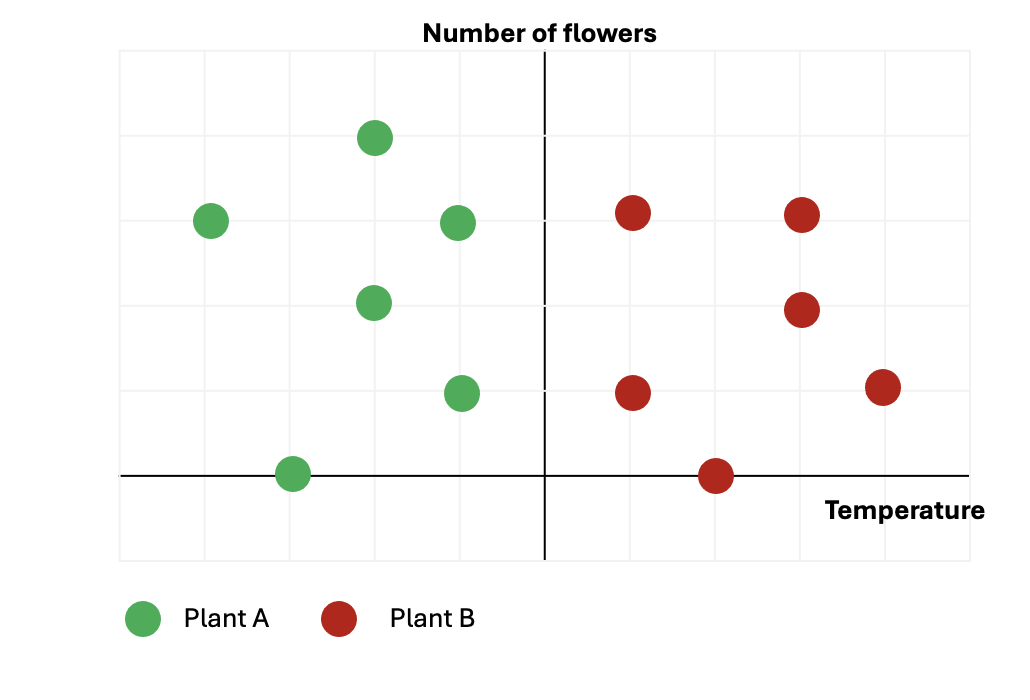
From inspection, the plants appear separable based on temperature.
Using a Vector to Classify
Instead of visually inspecting the plot, we can define a vector that separates the two classes.
For example, consider the vector:
[ = (2, 0) ]
We compute the dot product between this vector and each plant:
[ ]
This gives a scalar value for each plant.
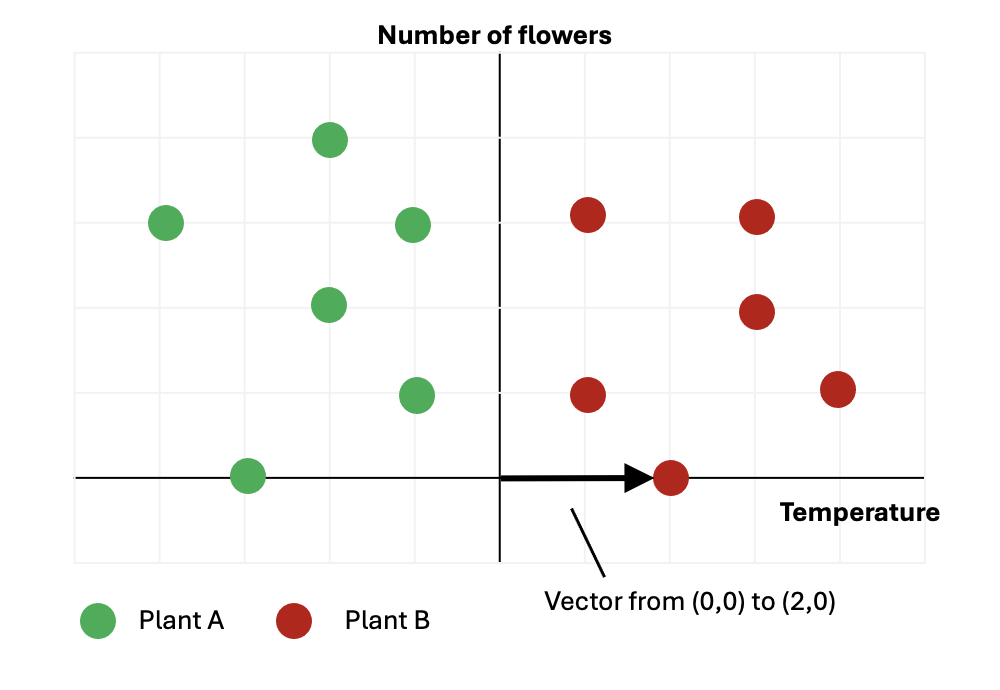
Classification Rule
- If ( > 0 ) → classify as Plant B
- If ( < 0 ) → classify as Plant A
Geometric Interpretation
The key idea:
- The vector defines a direction
- The decision boundary is a line perpendicular to that vector
- This line separates the two classes
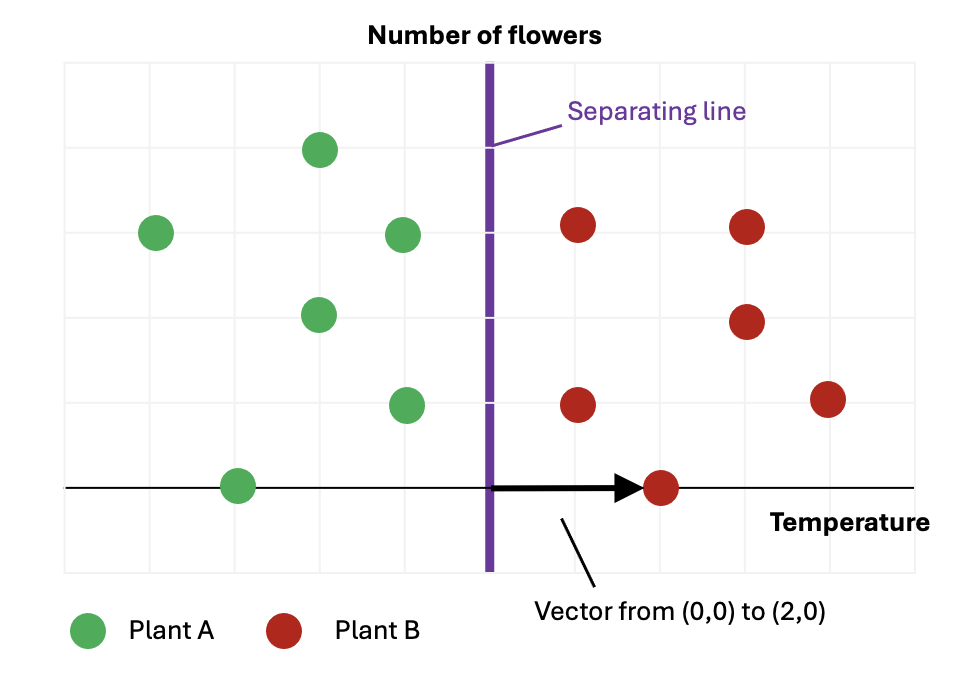
Any point on one side of the boundary has a positive dot product, and any point on the other side has a negative dot product.
Key Insight
Classification reduces to finding a vector such that:
- Points from one class produce positive dot products
- Points from the other class produce negative dot products
This is the foundation of many classification algorithms, including linear classifiers such as logistic regression and support vector machines.